
Moving Equity From Washington Into Las Vegas Real Estate? How a 1031 Exchange Can Defer the Tax
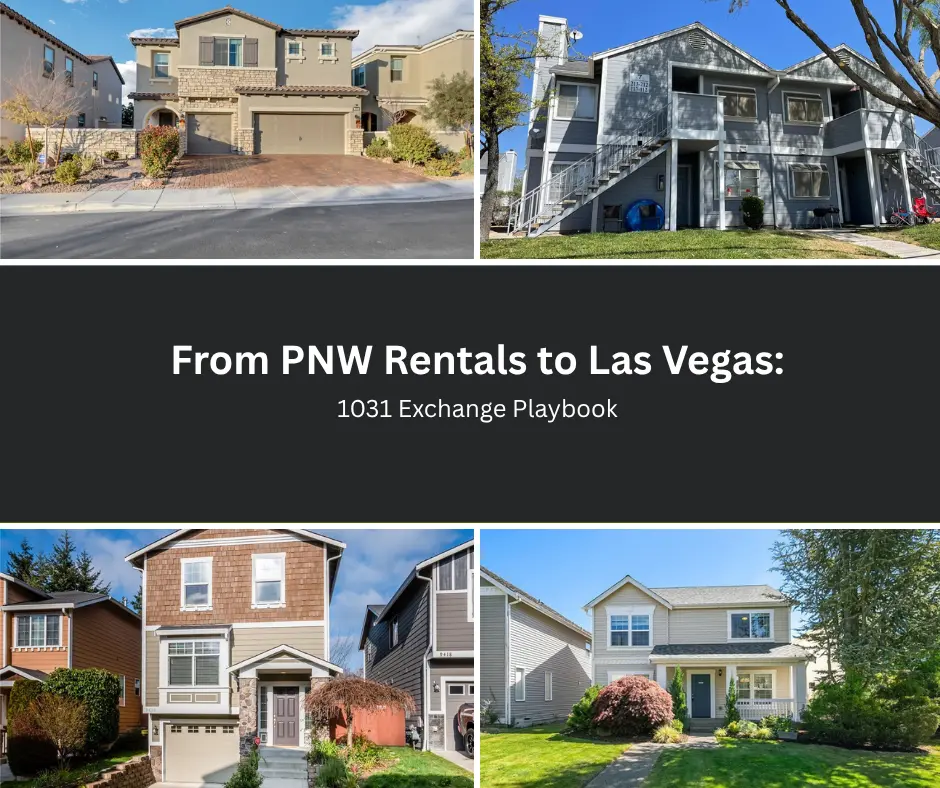
Why a 1031 Exchange is Your Strongest Play When Moving Equity Into Las Vegas Real Estate
Navigating Cross-State Portfolios and Tax Deferral with Firsthand Experience
Understanding the True Cost of Cashing Out Your Pacific Northwest Rental
Selling an investment property can create a tax bill. The amount depends on your taxable gain, income, depreciation history and other circumstances. Federal long-term capital gains rates can be 0, 15 or 20 percent; some investors also owe the 3.8 percent Net Investment Income Tax. Gain attributable to depreciation may face different rules, including a maximum 25 percent rate for unrecaptured Section 1250 gain. Ask your CPA to calculate your actual liability before deciding whether to sell or exchange.
Note: Washington's capital gains excise tax exempts real estate sales. The state has also passed a new 9.9 percent tax on annual income over 1 million dollars, which starts on January 1, 2028. The real estate exemption does not mean there are no other state taxes: Washington's Real Estate Excise Tax generally applies to property sales, with local rates and exemptions as well. As you evaluate your options, including getting a professional home valuation, timing your exit with your CPA is everything.
Knowing When to Hold and When to Pivot
The reality is that real estate moves in cycles, and not every property needs to be sold right this second. Sometimes local home prices dip or leasing friction spikes, like when an Everett rental that used to have a line out the door suddenly sits vacant for a couple of months, and the smartest, most honest move is simply holding tight to ride it out. We believe in straight talk and zero pressure: if holding your PNW asset makes the most sense right now, that is exactly what we do, and what we will tell you.
Other times, you look at an intensive, high friction asset and realize it is time for a strategic pivot. We have lived it ourselves; we actually traded a hands-on multi-family fourplex right here in Nevada into a single-family rental using a 1031 exchange.
Firsthand Experience in Both Washington and Nevada
We are investors ourselves, with investments in both Washington and Nevada, so we can share our personal, genuine experience of these decisions - and we know execution is everything. Manesh is licensed in both Washington and Nevada and Tania is licensed in Washington, so as a team we help clients on both sides of the bridge, whether that means timing a hold, planning a 1031 exchange with your CPA and Qualified Intermediary, or changing the type of property you own.
Section 1031 of the Internal Revenue Code may allow you to defer federal tax on the gain when you exchange real property held for investment or business use and meet all the requirements. The sections below cover the key deadlines and conditions.
The Core Financial Benefits
Tax Deferral Keeps More of Your Equity Working
Rather than paying federal tax upfront on the sale, a properly structured exchange rolls your proceeds into the next property, so more of your equity stays invested. Whether all of the gain is deferred depends on the gain itself, how much you reinvest, any cash or other property you receive, and changes in your debt - your CPA and Qualified Intermediary will calculate the numbers for your situation before you commit.
For some investors, moving equity from the Pacific Northwest into the Las Vegas Valley is simply a way to change the type of rental they own, in a state with no income tax.
Estate Planning and the Step-Up in Basis
Under current law, a chain of 1031 exchanges can stretch across your investing lifetime. If the property is still held when you die, your heirs' tax basis in it is generally its fair market value at the date of death, rather than what you paid for it. The details depend on your wider estate, so involve your CPA or attorney in that part of the plan.
The IRS Deadlines: 45 Days and 180 Days
The 45-Day Identification Window
The clock starts the day your relinquished property transfers. You then have 45 calendar days to identify potential replacement properties in writing, in a document you sign and deliver to your Qualified Intermediary. You can identify more than one property, and your Qualified Intermediary will confirm exactly how many the rules allow for your exchange.
The 180-Day Closing Deadline
You must close on your replacement property within 180 calendar days of your original sale or by your tax return due date, including extensions, whichever comes first. These are calendar days. Limited IRS relief exists, for example for taxpayers affected by federally declared disasters, but never assume an extension applies - your Qualified Intermediary will confirm your exact dates.
The Boot Trap Can Trigger Accidental Tax Liability
Boot is any cash or other value you receive from the exchange that is not reinvested in the like-kind property - for example leftover cash, or a lower mortgage on the new property without extra cash to cover the difference. Boot can trigger tax, limited to the gain you made on the sale, and in some cases cash you add can offset a difference in debt. Your CPA and Qualified Intermediary will work out whether any boot applies to you and how much is taxable.
Using a Qualified Intermediary
In a deferred exchange you cannot receive or control the sale proceeds, even for a moment. A Qualified Intermediary sets up a written exchange agreement designed to avoid actual or constructive receipt of the funds, and holds the money between your sale and your purchase. Arrange the QI before your sale closes - it cannot be added afterwards.
Frequently Asked Questions About 1031 Exchanges
What is a Qualified Intermediary and Why Do I Need One?
A Qualified Intermediary is an independent third party who holds your exchange proceeds between the sale of your relinquished property and the purchase of your replacement property, under a written exchange agreement. It is the standard route the IRS provides for a deferred exchange: if the proceeds pass through your hands or an account you control, that counts as constructive receipt and the exchange can be disqualified. Your QI also prepares the exchange documents, so bring one in before your sale closes.
What is Boot and How Does It Trigger Taxes?
Boot is any cash or other value you receive from the exchange that is not reinvested in the like-kind property - for example leftover cash, or a lower mortgage on the new property without extra cash to cover the difference. Boot can trigger tax, limited to the gain you made on the sale, and in some cases cash you add can offset a difference in debt. Your CPA and Qualified Intermediary will calculate whether any boot applies to you.
Can I Use a 1031 Exchange to Buy a New Primary Residence?
No. This is one of the most common misconceptions. Section 1031 applies to property held for investment or business use. If you are selling your main home, look instead to IRS Section 121, which lets eligible homeowners exclude up to $250,000 of gain, or $500,000 for married couples filing jointly. Also worth knowing: if you exchange into a rental and later make it your main home, extra rules apply before you can use the Section 121 exclusion - in general a five-year wait after the exchange, among other requirements. Your CPA can map out the details.
Does the Same Entity Rule Matter for My Exchange?
Yes. The taxpayer that sells the relinquished property must be the same taxpayer that buys the replacement property. The name on the title is not always the test: a disregarded single-member LLC or a grantor trust can be treated as the same taxpayer as its owner. What matters is how each entity is classified for federal tax, so confirm the ownership and tax classification on both sides with your CPA and Qualified Intermediary before your sale closes, not after.
What Happens If I Miss the 45-Day Identification or 180-Day Closing Window?
Miss either deadline and the exchange fails, and the gain on your sale becomes taxable. The 180-day window can also end sooner: it closes at your tax return due date, including extensions, for the year of the sale if that comes first. Limited IRS relief exists, for example for taxpayers affected by federally declared disasters, but never assume an extension applies - your Qualified Intermediary will confirm your exact dates.
Making the Leap from Washington to Nevada
Your Custom Blueprint for Cross-State Real Estate Success
Moving an investment portfolio across state lines, or restructuring what you own locally, takes a clear plan. We have investments in both Washington and Nevada ourselves, including a Nevada fourplex we traded into a single-family rental through our own 1031 exchange, so we can share our personal, genuine experience at every step. We guide you through the process with honest advice and zero pressure, keeping the timelines straight, enabling you to keep your CPA and Qualified Intermediary in sync.
This article is general information only and is not tax, legal, or investment advice.
Always consult a qualified certified public accountant or tax professional regarding your individual financial situation before initiating a 1031 exchange or cross-state portfolio transition.
Not doing an exchange? Do not worry, whether you are buying your first rental, relocating across state lines, or just exploring your options, we are still here to help you navigate every step of the journey with zero pressure.
Thinking about executing a 1031 exchange into the Las Vegas market?
Call us to learn more, and work out what's possible for you:
WA: (425) 623-3958 Explore our Seattle pages
NV: (725) 300-6899 Explore our Las Vegas pages
Request a home valuation
Sources checked (October 29, 2026)
IRS Topic 409, Capital Gains and Losses (page updated September 24, 2026) - 0/15/20 rate structure; unrecaptured Section 1250 gain maximum 25%: https://www.irs.gov/taxtopics/tc409
IRS Net Investment Income Tax - 3.8%, thresholds $250,000 / $200,000 / $125,000: https://www.irs.gov/individuals/net-investment-income-tax
Instructions for Form 8824 (2025) - 45-day identification; 180 days or tax return due date including extensions, whichever earlier; QI exchange as one safe harbor: https://www.irs.gov/instructions/i8824
IRS Rev. Proc. 2018-58, section 17 - postponement of 1031 deadlines for federally declared disasters: https://www.irs.gov/pub/irs-drop/rp-18-58.pdf
IRS Like-Kind Exchanges, Real Estate Tax Tips - real property held for investment or business use; boot recognized to the extent received: https://www.irs.gov/businesses/small-businesses-self-employed/like-kind-exchanges-real-estate-tax-tips
IRS Pub 523, Selling Your Home - Section 121 exclusion $250,000 / $500,000; five-year holding rule under Section 121(d)(10): https://www.irs.gov/publications/p523
IRS Pub 551, Basis of Assets - inherited property basis is fair market value at date of death (Section 1014): https://www.irs.gov/publications/p551
Washington DOR, Capital gains tax - 7% excise tax; real estate exempt: https://dor.wa.gov/taxes-rates/other-taxes/capital-gains-tax
Washington DOR, Income tax - new 9.9% tax on annual adjusted gross income over $1 million, effective January 1, 2028, first returns due 2029: https://dor.wa.gov/taxes-rates/income-tax
Governor's office - Millionaires' Tax (SB 6346) signed into law, March 2026: https://governor.wa.gov/news/2026/governor-ferguson-signs-millionaires-tax-law
Washington DOR, Real estate excise tax - graduated state rates; local REET and exemptions exist: https://dor.wa.gov/taxes-rates/other-taxes/real-estate-excise-tax
Categories
Recent Posts










Whenever you are ready, we are here to help. Honesty guaranteed.
Real Estate Done Right.
NV (725) 300-6899